If you’re building a Milwaukee cordless tool collection, one of the first decisions you’ll face is whether to choose the M12 or M18 platform.
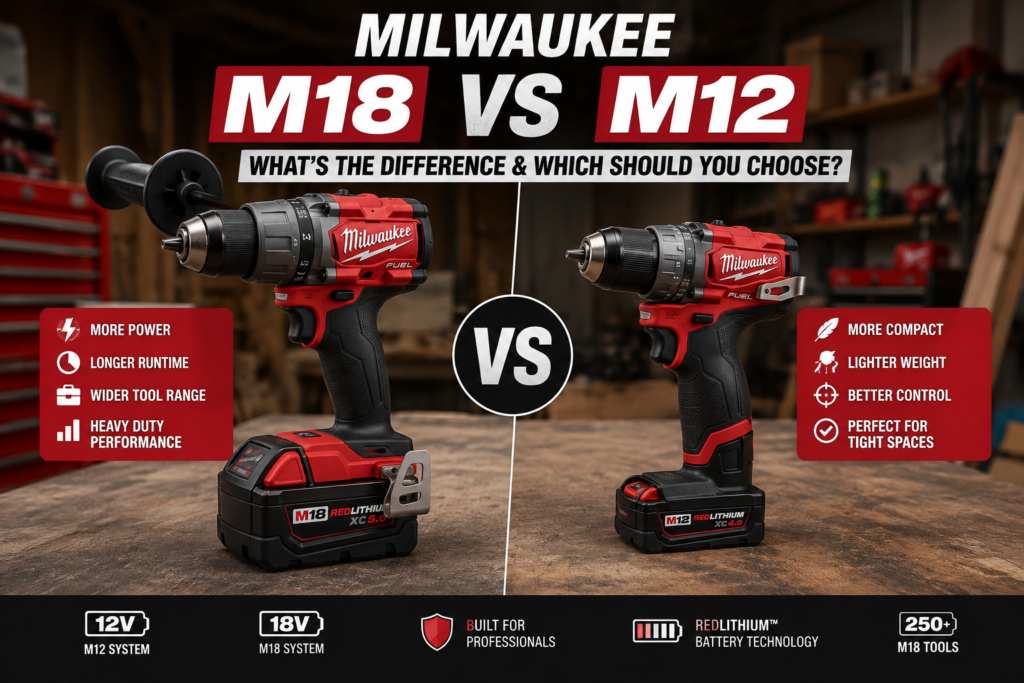
Both systems are designed around Milwaukee’s REDLITHIUM battery technology, but they serve different purposes. M12 focuses on compact tools and applications where size and maneuverability matter. M18 is the larger platform, designed for a broader range of demanding applications and higher-power tools.
So, which one should you choose?
The answer depends less on which platform is “better” and more on what kind of work you actually do.
Milwaukee M12 vs M18 at a Glance
| Feature | Milwaukee M12 | Milwaukee M18 |
|---|---|---|
| Nominal voltage | 12V | 18V |
| Platform focus | Compact tools | Full-size cordless tools |
| Best for | Tight spaces, light-duty and precision work | Demanding drilling, fastening, cutting and other heavy-duty applications |
| Battery compatibility | M12 tools and chargers | M18 tools and chargers |
| Size | Smaller and lighter tool options | Larger tool options |
| Best reason to choose | Compactness and control | Power, runtime and broader tool selection |
Milwaukee states that its M12 and M18 batteries are dedicated to their respective systems. M12 batteries work with M12 tools and chargers, while M18 batteries work with M18 tools and chargers.
What Is Milwaukee M12?
Milwaukee M12 is the company’s compact 12V cordless platform.
The main advantage isn’t simply the lower voltage. It’s the small size of the tools and batteries.
That makes M12 particularly useful when you need to work in confined spaces or want a tool that is easy to handle for extended periods.
M12 can make sense for applications such as:
- Electrical work
- Plumbing and HVAC service
- Cabinet and installation work
- Maintenance
- Light-duty drilling and fastening
- Tight-access jobs
- Overhead work where reducing tool weight matters
For these applications, having the smallest possible tool can be more valuable than having maximum power.
Why Choose M12?
The biggest reason to choose M12 is compactness.
A smaller tool can be easier to position inside cabinets, mechanical spaces and other areas where a full-size tool becomes awkward.
M12 also makes sense if your work involves lots of repetitive fastening or overhead use where reducing hand and arm fatigue is important.
That doesn’t mean M12 tools are simply “weaker versions” of M18 tools. Milwaukee has built the M12 platform around applications where compact size is itself an advantage.
What Is Milwaukee M18?
M18 is Milwaukee’s 18V cordless platform and is aimed at a much broader range of demanding applications.
The M18 family includes drills, impact drivers, impact wrenches, saws and many other professional-oriented cordless tools.
Milwaukee currently describes the M18 system as a large ecosystem, with its product pages highlighting hundreds of M18 solutions. For example, Milwaukee’s current M18 REDLITHIUM FORGE HD12.0 starter kit describes compatibility with more than 275 M18 solutions.
M18 is generally the better starting point when you need:
- More demanding drilling
- Higher-demand fastening
- Cutting
- Construction work
- Longer-duration applications
- A broad cordless tool ecosystem
- Larger professional tools
If you’re looking for one cordless platform to cover a large portion of a construction or workshop tool collection, M18 is usually the more versatile starting point.
If you are comparing complete cordless tool platforms, our Milwaukee M18 vs DeWalt 20V comparison can help you decide which ecosystem is a better fit.
M12 vs M18: The Biggest Differences
1. Power
The most obvious difference is voltage.
M12 is a 12V platform, while M18 is an 18V platform.
But voltage alone doesn’t tell you exactly how a particular tool will perform. Tool design, motor technology, gearing, battery pack and the application all matter.
In practical terms, however, M18 is the platform to consider when your work requires higher power and more demanding applications.
M12’s strength is doing useful work while keeping the tool compact.
2. Size and Weight
This is where M12 can have a major advantage.
M12 tools are designed around a compact form factor, making them easier to maneuver in tight spaces.
If you spend your day working inside cabinets, around appliances, in service panels or in other restricted areas, the smaller M12 platform can be extremely useful.
M18 tools generally occupy a larger physical footprint because they’re designed for a broader range of high-demand applications.
The important question isn’t simply:
“Which platform has more power?”
Instead ask:
“How much power do I actually need for the work I do?”
If the answer is “not much, but I need a small tool,” M12 can be the smarter choice.
3. Tool Selection
M18 has a very broad tool ecosystem and is the platform to look at when you want a cordless collection that covers demanding construction and workshop applications.
M12, meanwhile, has a strong emphasis on compact and specialized tools.
Milwaukee’s current battery information separates the two systems clearly: M12 tools use M12 REDLITHIUM batteries, while M18 tools use M18 REDLITHIUM batteries.
This means your first platform decision can influence which tools and batteries you buy later.
4. Battery Compatibility
This is one of the most important things to understand before buying.
M12 and M18 batteries are not interchangeable.
An M12 battery is designed for M12 tools.
An M18 battery is designed for M18 tools.
Milwaukee explicitly states that all M12 batteries are compatible with M12 tools and chargers, while M18 batteries are compatible with M18 tools and chargers.
So if you start with M12 and later decide you need M18 tools, you will need to invest in the M18 battery platform as well.
The good news is that Milwaukee offers chargers that can accept both systems. Its M18 & M12 Multi-Voltage Charger is designed to charge both M12 and M18 battery packs.
5. Runtime
Runtime depends heavily on the specific battery and tool.
Milwaukee offers different battery capacities and battery families within both platforms.
For M18, Milwaukee currently offers standard REDLITHIUM, HIGH OUTPUT and REDLITHIUM FORGE battery options. Milwaukee says its FORGE batteries are designed for high power, fast charging and long life.
This means you shouldn’t judge runtime simply by comparing M12 and M18 labels.
Instead, compare the specific tool + battery combination you’re considering.
Which Is Better for DIYers?
For many DIY users, either platform can make sense.
Choose M12 if your projects mainly involve:
- Furniture assembly
- Cabinet installation
- Small repairs
- Light drilling
- Tight spaces
- Occasional maintenance
- Tasks where tool size matters
Choose M18 if your projects regularly involve:
- Construction
- Larger drilling jobs
- Heavy fastening
- Cutting
- Deck building
- Remodeling
- More demanding workshop work
If you’re buying your first cordless platform and expect your needs to grow over time, M18 can provide a broader foundation.
But if your priority is having compact tools that are easy to carry and maneuver, M12 may be the better fit.
Which Is Better for Professionals?
For professionals, the answer depends heavily on the trade.
An electrician, service technician or installer may find M12 extremely valuable because compact tools can make tight-access work easier.
A contractor or construction professional who regularly needs high-power drills, saws, impacts and other heavy-duty equipment may want M18 as the primary platform.
In many cases, professionals don’t have to choose only one.
M12 and M18 can complement each other.
You might use M18 for your primary high-power tools and keep selected M12 tools for applications where compact size provides a real advantage.
Can You Use an M12 Battery in an M18 Tool?
No.
M12 and M18 are separate battery systems.
Milwaukee’s own guidance says that batteries are interchangeable within their respective systems but not across the M12, M18 and MX FUEL platforms.
So:
M12 battery → M12 tool
M18 battery → M18 tool
Do not attempt to force a battery into a tool for which it isn’t designed.
Can One Charger Charge Both M12 and M18 Batteries?
Yes—if you use a Milwaukee charger designed for both platforms.
For example, Milwaukee’s M18 & M12 Multi-Voltage Charger accepts both M12 and M18 battery packs. Milwaukee also offers other chargers designed to handle both battery families.
This is useful if you eventually build a mixed M12/M18 collection.
However, remember that charger compatibility does not mean battery-to-tool compatibility.
A charger can support both platforms while the batteries remain dedicated to their respective tools.
Should You Buy M12 or M18 First?
Here’s the simplest way to decide.
Choose M12 First If:
- Compact size is your priority.
- You work in tight spaces.
- You do installation or service work.
- You want lightweight tools.
- Your projects are mostly light to medium duty.
- You already know you don’t need large high-power tools.
Choose M18 First If:
- You want one primary cordless platform.
- You regularly perform demanding work.
- You need higher-power tools.
- You’re building a larger professional tool collection.
- You work in construction or remodeling.
- You expect to add saws, impacts and other full-size tools.
Consider Both If:
Your work combines compact service tasks with demanding applications.
For example, you might use an M18 drill or impact for demanding jobs while keeping an M12 ratchet, driver or other compact tool available for tight spaces.
The two platforms don’t have to compete for the same job.
Milwaukee M12 vs M18: Our Verdict
There isn’t a universal winner.
M12 wins when compact size, maneuverability and reduced tool bulk are the priority.
M18 wins when power, demanding applications and a broad full-size cordless ecosystem are more important.
For a homeowner who mostly performs small repairs, M12 can provide more than enough capability.
For someone building a professional-grade cordless collection, M18 is generally the stronger foundation.
And for professionals who encounter a wide range of jobs, owning both can make sense.
The most important thing is to choose your platform based on the work you actually do—not simply the higher voltage printed on the battery.
Frequently Asked Questions
Is Milwaukee M12 or M18 more powerful?
M18 is the higher-voltage platform and is designed for more demanding applications. However, actual performance depends on the specific tool, motor, gearing and battery.
Are M12 and M18 batteries interchangeable?
No. M12 batteries are designed for M12 tools, while M18 batteries are designed for M18 tools.
Can an M18 charger charge an M12 battery?
A charger specifically designed for M12/M18 charging can charge both. Milwaukee offers multi-voltage chargers that accept both M12 and M18 battery packs.
Is M12 good enough for professional work?
Yes. M12 can be an excellent professional platform for applications where compact size and maneuverability are important. The right choice depends on the trade and the specific tools required.
Should I start with M12 or M18?
Start with M12 if compact tools are your main priority. Start with M18 if you need a broader range of high-power cordless tools. If your work requires both, consider using the two platforms together.
Final Takeaway
Milwaukee M12 and M18 aren’t simply two versions of the same system.
They are designed around different priorities.
M12 is about compact cordless power.
M18 is about broader, higher-demand cordless capability.
Choose the platform that matches your work, then build your battery and tool collection around it.
For many users, the smartest long-term approach may not be choosing one platform exclusively—it may be starting with the platform that handles most of your work and adding the other when a specific application makes it worthwhile.