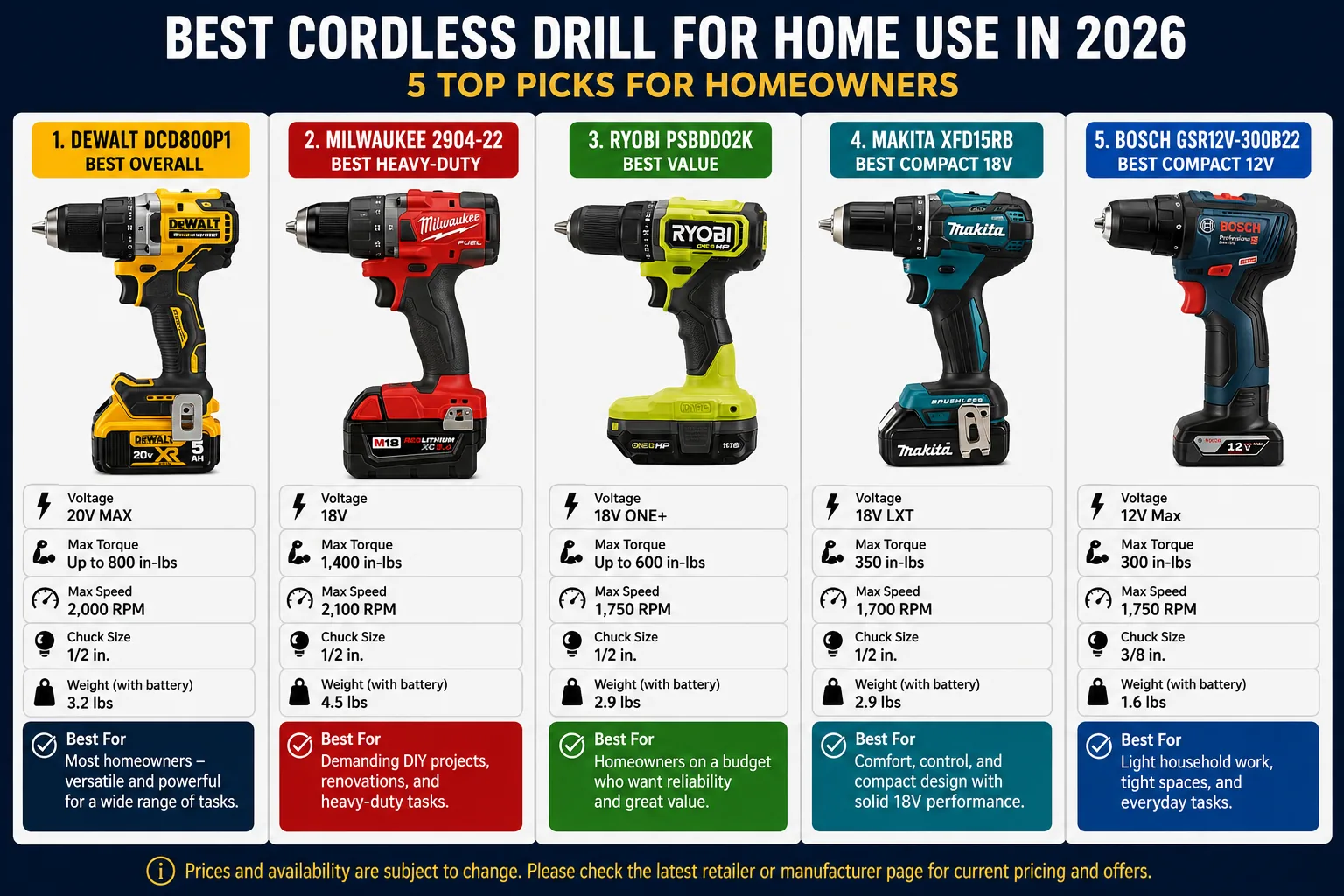
If you are looking for the best cordless drill for home use, you do not necessarily need the most powerful or most expensive model. For most homeowners, the ideal drill should be easy to handle, reliable, versatile, and powerful enough for everyday jobs such as assembling furniture, hanging shelves, installing hardware, drilling pilot holes, and completing basic home repairs.
The best choice also depends on the type of projects you expect to do. A compact 12V drill can be excellent for light household work, while an 18V or 20V MAX drill provides more power and versatility for larger DIY projects.
In this guide, we compare five cordless drills from DeWalt, Milwaukee, Ryobi, Makita, and Bosch to help you choose the right model for your home.
Quick Picks
| Pick | Model | Best For |
|---|---|---|
| Best Overall | DEWALT DCD800P1 | Most homeowners |
| Best Heavy-Duty | Milwaukee M18 FUEL 2904-22 | Demanding DIY projects |
| Best Value | RYOBI ONE+ HP PSBDD02K | Homeowners on a budget |
| Best Compact 18V | Makita XFD15RB | Comfort and portability |
| Best Compact 12V | Bosch GSR12V-300B22 | Light household work |
1. DEWALT DCD800P1 — Best Overall
The DEWALT DCD800 is a strong all-around option for homeowners who want one cordless drill that can handle a wide range of household and DIY projects.
The DCD800 uses DEWALT’s 20V MAX XR platform and features a brushless motor, a 1/2-inch metal ratcheting chuck, variable speed, and two-speed transmission. DEWALT lists a maximum speed of 2,000 RPM and a compact 6.37-inch tool length. The tool also has a three-mode LED light for improved visibility.
The DCD800P1 kit includes the drill, a 20V MAX 5.0Ah battery, charger, and storage bag. A current Home Depot listing showed the kit at about $239 when checked, but retailer pricing and promotions can change.
Why We Recommend It
- Brushless motor
- 1/2-inch metal ratcheting chuck
- Up to 2,000 RPM
- Compact 6.37-inch tool length
- Large DEWALT 20V MAX ecosystem
- Good balance of power and portability
Best For
Homeowners who want one versatile drill for furniture assembly, repairs, woodworking, shelving, hardware installation, and larger DIY projects.
Potential Drawback
The DCD800 is more drill than many homeowners need for very light tasks. If you mainly assemble furniture or work in tight spaces, a compact 12V model may be easier to handle.
2. Milwaukee M18 FUEL 2904-22 — Best for Heavy-Duty Work
The Milwaukee M18 FUEL 2904-22 is designed for users who want considerably more power.
Milwaukee lists 1,400 in-lbs of torque and up to 2,100 RPM. The 2904-20 tool has a 1/2-inch all-metal ratcheting chuck, POWERSTATE brushless motor, REDLINK PLUS intelligence, and an AutoStop control feature designed to help reduce over-rotation during bind-ups. It is also a hammer drill, making it suitable for drilling in brick, block, and concrete.
The 2904-22 kit includes the drill, two M18 REDLITHIUM XC5.0 batteries, an M18/M12 multi-voltage charger, side handle, belt clip, and carrying case.
When checked, Home Depot listed the 2904-22 kit at $329.
Why We Recommend It
- 1,400 in-lbs of torque
- Up to 2,100 RPM
- Brushless POWERSTATE motor
- 1/2-inch all-metal chuck
- Hammer-drill capability
- AutoStop control
- Large M18 battery ecosystem
- If you are deciding between Milwaukee’s two popular battery platforms, read our Milwaukee M18 vs M12 comparison.
Best For
Serious DIYers, homeowners doing renovation work, woodworking, large-hole drilling, and users who expect professional-level performance.
Potential Drawback
It is more expensive and more powerful than necessary for simple household tasks.
3. RYOBI ONE+ HP PSBDD02K — Best Value
The RYOBI ONE+ HP compact brushless drill is an attractive option for homeowners who want a capable cordless drill without spending as much as they might on a professional-oriented platform.
The PSBDD02K is an 18V ONE+ HP brushless compact drill/driver kit. Current Home Depot listings show the kit with an 18V 2.0Ah HIGH PERFORMANCE battery and charger. The listed price was about $99 when checked.
The biggest advantage of Ryobi is its ONE+ ecosystem. Once you own a compatible battery, you can use it across a large range of ONE+ tools.
Why We Recommend It
- Brushless motor
- Compact design
- 18V ONE+ platform
- Large range of compatible tools
- Battery and charger included in the kit
- Attractive price for homeowners
Best For
DIYers, homeowners, beginners, and anyone building their first cordless tool collection.
Potential Drawback
If you regularly perform demanding professional-level work, a higher-end Milwaukee or DEWALT platform may be a better fit.
4. Makita XFD15RB — Best Compact 18V Option
The Makita XFD15RB is a compact 18V LXT sub-compact brushless driver-drill designed for users who want a balance of performance, size, and comfort.
Makita lists 350 in-lbs of maximum torque, a two-speed range up to 1,700 RPM, a 5-7/8-inch overall length, and a weight of about 2.9 pounds with battery. It also has a brushless motor, metal gear housing, and dual LED lights.
The XFD15RB kit includes the drill, two 18V LXT 2.0Ah batteries, rapid charger, and tool bag.
Why We Recommend It
- Compact 5-7/8-inch length
- 350 in-lbs maximum torque
- Up to 1,700 RPM
- Brushless motor
- 18V LXT battery platform
- Lightweight design
Best For
Homeowners who value comfort, compact size, and good control while still wanting an 18V platform.
Potential Drawback
It is not intended to compete with the maximum power output of large heavy-duty drills such as the Milwaukee M18 FUEL 2904.
5. Bosch GSR12V-300B22 — Best Compact 12V Option
If most of your projects involve light household work, a compact 12V drill can be a better choice than a large 18V or 20V model.
The Bosch GSR12V-300B22 uses a brushless EC motor and provides 300 in-lbs of torque with a maximum speed of 1,750 RPM. Bosch lists a compact 6-inch head length and a tool-only weight of 1.6 pounds.
The kit includes two 12V 2.0Ah batteries, a charger, bits, belt clip, and carrying bag.
Why We Recommend It
- Very compact design
- 1.6-pound tool-only weight
- 300 in-lbs of torque
- Up to 1,750 RPM
- Brushless motor
- Two batteries included
Best For
Furniture assembly, cabinet hardware, shelving, light repairs, small drilling jobs, and work in tight spaces.
Potential Drawback
A 12V drill is not the best choice for large holes, heavy construction, or demanding renovation work.
12V vs. 18V vs. 20V MAX: Which Should You Choose?
The voltage rating is one of the first things shoppers notice, but it should not be the only factor you consider.
Choose 12V if:
- You mainly perform light household tasks
- You want the smallest and lightest drill
- You work in tight spaces
- You assemble furniture frequently
- Portability is more important than maximum power
The Bosch GSR12V-300 is a good example of this type of compact drill.
Choose 18V if:
- You want a versatile general-purpose drill
- You perform regular DIY work
- You want access to a large cordless tool ecosystem
- You need more capability than a compact 12V drill
Makita’s XFD15RB and Milwaukee’s M18 platform are examples of 18V systems.
Choose 20V MAX if:
- You regularly work on larger projects
- You drill larger holes
- You use longer screws
- You want a powerful general-purpose platform
DEWALT’s 20V MAX XR DCD800 is an example of a compact but powerful 20V MAX drill/driver.
Is 20V More Powerful Than 18V?
Not necessarily.
DEWALT explains that its 20V MAX battery has a maximum initial voltage of 20 volts without workload, while the nominal voltage is 18 volts. Therefore, you should not judge drill performance simply by comparing an 18V label with a 20V MAX label.
Instead, compare the actual tool’s design, motor, torque, speed, size, battery system, and intended application.
Do You Need a Hammer Drill?
Not every homeowner needs a hammer drill.
A standard drill/driver is sufficient for many common tasks such as:
- Driving screws
- Drilling wood
- Drilling plastic
- Drilling metal
- Furniture assembly
- Installing hardware
A hammer-drill function becomes useful when drilling into masonry such as brick, block, or concrete.
For example, the Milwaukee 2904-22 includes a hammer-drill mode specifically for masonry applications.
If you regularly drill into concrete, however, a dedicated rotary hammer may be a better choice.
Brushless vs. Brushed: Which Is Better?
For a new cordless drill, a brushless motor is usually the better long-term choice if it fits your budget.
The models covered in this guide use brushless motors:
- DEWALT DCD800
- Milwaukee M18 FUEL 2904
- RYOBI ONE+ HP
- Makita XFD15RB
- Bosch GSR12V-300
Brushless designs are commonly chosen for their efficiency, reduced maintenance requirements, and strong performance.
However, you do not need to spend heavily on a premium brushless drill if you only use a drill a few times a year for very simple tasks.
Drill/Driver vs. Impact Driver
A drill/driver is usually the better first cordless tool for a homeowner because it can drill holes and drive screws while providing adjustable clutch settings.
An impact driver is particularly useful for driving long screws and larger fasteners.
If you are buying your first cordless tool, start with a drill/driver.
If you already own a drill, adding an impact driver can make your tool collection more versatile.
If you are looking for a dedicated tool for driving long screws and heavy fasteners, see our guide to the Best Cordless Impact Driver in 2026.
What Chuck Size Should You Choose?
A 1/2-inch chuck is a versatile choice for a general-purpose homeowner drill.
The DEWALT DCD800 and Milwaukee 2904 both use 1/2-inch chucks.
A smaller 3/8-inch chuck can still be perfectly suitable for light household applications. The Bosch GSR12V-300 uses a 3/8-inch keyless chuck.
What Battery Size Should You Buy?
Battery capacity affects both runtime and weight.
A smaller battery can make a drill lighter and easier to handle.
A larger battery can provide longer runtime but adds weight.
For light household work, a compact battery can be convenient. For long projects, a higher-capacity battery may reduce the number of charging breaks.
For your first cordless platform, it is also worth considering what other tools you may buy later. A battery system can eventually power drills, impact drivers, saws, lights, sanders, and other tools.
Which Cordless Drill Is Best for Most Homeowners?
For most homeowners, we would start with the DEWALT DCD800P1.
It provides a useful combination of power, compact size, brushless performance, a 1/2-inch chuck, and access to the large DEWALT 20V MAX ecosystem.
However, that does not mean it is the best choice for everyone.
Choose Milwaukee M18 FUEL 2904-22 if you need substantially more power and expect to tackle demanding DIY or renovation projects.
Choose RYOBI ONE+ HP PSBDD02K if value and a large homeowner-focused tool ecosystem are your priorities.
Choose Makita XFD15RB if compact size, comfort, and an 18V platform are especially important to you.
Choose Bosch GSR12V-300B22 if your work is mostly light-duty and you want a particularly small and lightweight drill.
Final Verdict
The best cordless drill for home use is the one that matches your projects rather than simply having the highest torque or voltage rating.
For a versatile first cordless drill, the DEWALT DCD800P1 is our best overall choice.
For demanding work, the Milwaukee M18 FUEL 2904-22 offers substantially more capability.
For value, the RYOBI ONE+ HP PSBDD02K is an attractive homeowner option.
For compact 18V performance, consider the Makita XFD15RB.
And for light household work where low weight matters most, the Bosch GSR12V-300B22 is a strong 12V choice.
Before purchasing, always check the exact kit contents, battery capacity, warranty, retailer price, and current availability. Tool bundles and promotional prices can change frequently.
Frequently Asked Questions
What is the best cordless drill for home use?
For most homeowners, the DEWALT DCD800P1 is a strong all-purpose choice because it combines a compact design, brushless motor, 1/2-inch chuck, and the DEWALT 20V MAX platform.
Is 12V enough for home use?
Yes. A 12V drill can be excellent for furniture assembly, cabinet hardware, shelving, small repairs, and other light-duty jobs. The Bosch GSR12V-300 is designed specifically around this compact form factor.
Is 18V better than 20V MAX?
No. The label alone does not determine performance. DEWALT’s 20V MAX system, for example, has a nominal voltage of 18V. Compare the actual tool specifications and intended use instead.
Is a brushless drill worth it?
For frequent users, a brushless drill is generally a worthwhile upgrade. It can provide efficient operation and strong performance while requiring less motor maintenance than traditional brushed designs.
Should I buy a drill kit or tool-only?
If you do not already own batteries and a charger from that platform, a kit is usually the more convenient starting point. If you already own compatible batteries, buying the tool-only version can reduce the cost.
Do I need a hammer drill?
Only if you regularly need to drill into masonry such as brick, block, or concrete. For ordinary wood, metal, screws, and household repairs, a standard drill/driver is usually enough.
What drill should a beginner buy?
A compact brushless 18V or 20V MAX drill is a good long-term choice for many beginners. If your work is limited to light household tasks, a compact 12V model can be easier and more comfortable to use.
Should I buy Milwaukee, DeWalt, Ryobi, Makita, or Bosch?
There is no single best brand for everyone. DeWalt and Milwaukee are strong choices for demanding users, Ryobi offers strong value for homeowners, Makita is attractive for users who prioritize compact professional tools, and Bosch offers excellent compact 12V options.
1 thought on “Best Cordless Drill for Home Use in 2026: 5 Top Picks for Homeowners”