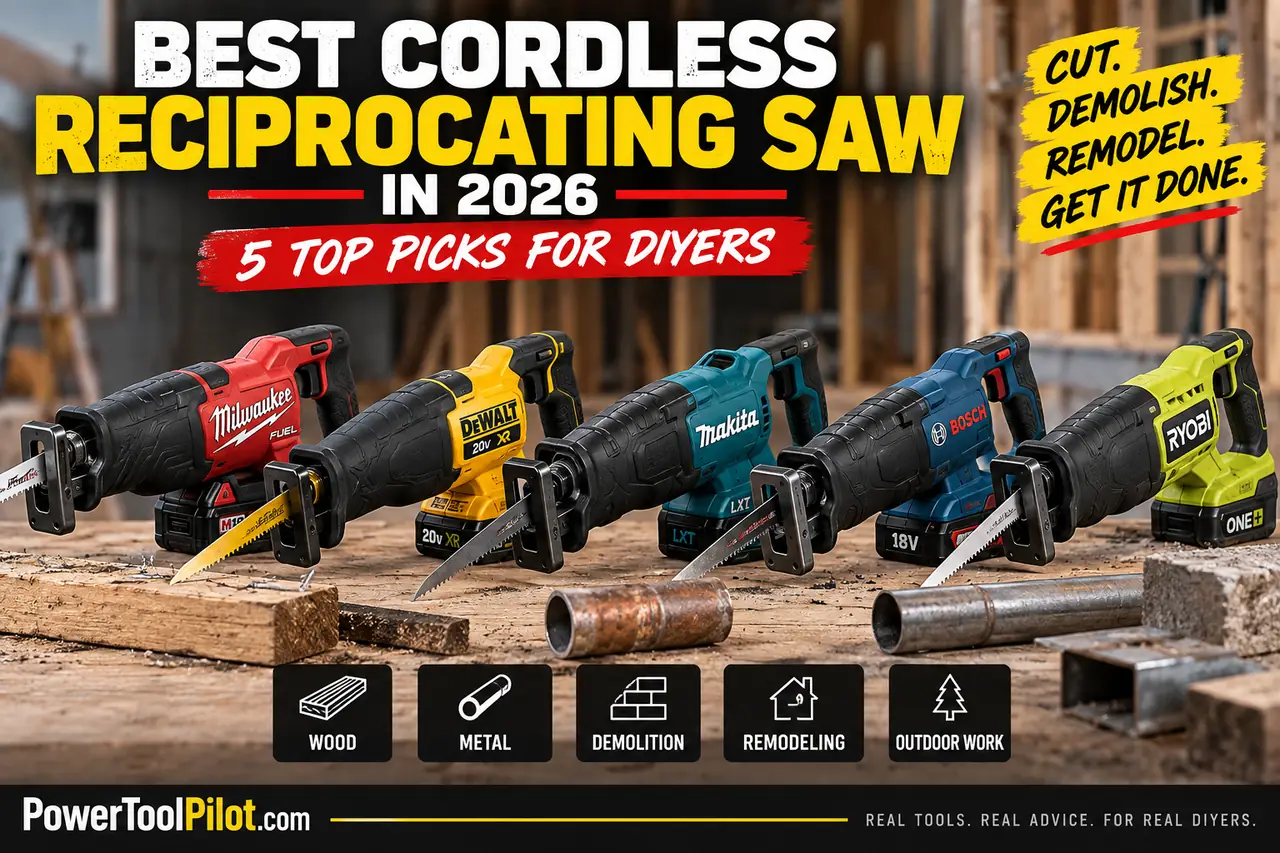
If you’re tearing out old flooring, cutting lumber, removing pipes, trimming branches, or tackling a demolition project, a cordless reciprocating saw can be one of the most useful tools in your workshop.
Unlike a circular saw, a reciprocating saw is designed for rough, fast cuts rather than perfectly straight finishes. Its long blade and compact cutting head make it especially useful when you need to cut in places where a conventional saw simply won’t fit.
The good news is that modern cordless models have become powerful enough for serious DIY and construction work.
In 2026, Milwaukee, DeWalt, Makita, Bosch, and Ryobi all offer strong cordless reciprocating saw options. The best choice depends on the type of work you do, how much power you need, and—most importantly—which battery platform you already own.
In this guide, we’ll compare 5 of the best cordless reciprocating saws in 2026 and explain which one is right for homeowners, DIYers, remodelers, and professionals.
Quick Comparison: Best Cordless Reciprocating Saws in 2026
| Model | Battery Platform | Best For | Stroke |
|---|---|---|---|
| Milwaukee M18 FUEL SAWZALL 2821-20 | M18 | Best Overall | 1-1/4″ |
| DeWalt DCS382B | 20V MAX | Best for DIYers | 1-1/8″ |
| Makita XRJ06Z | 18V LXT X2 | Best Heavy-Duty Makita Option | 1-1/4″ |
| Bosch GSA18V-125 | 18V | Best for Control | 1-1/4″ |
| Ryobi PBLRS02B | 18V ONE+ | Best Value | 1-1/4″ |
Note: Battery, charger, included blades, and kit contents can vary by package. Always check the exact model and kit before purchasing.
1. Milwaukee M18 FUEL SAWZALL 2821-20 — Best Overall
If you want a cordless reciprocating saw for demanding work, the Milwaukee M18 FUEL SAWZALL 2821-20 is one of the strongest options available.
The 2821-20 uses Milwaukee’s M18 battery platform and features a POWERSTATE brushless motor. Milwaukee rates it at up to 3,000 strokes per minute with a 1-1/4-inch stroke length, giving it the aggressive cutting performance expected from a professional reciprocating saw.
It also includes an adjustable shoe, LED light, tool-free QUIK-LOK blade clamp, and REDLINK PLUS electronics for overload and overheating protection.
Best For
- Demolition
- Remodeling
- Cutting lumber
- Cutting metal pipe
- Construction
- Heavy-duty DIY
- Milwaukee M18 users
Key Features
- POWERSTATE brushless motor
- Up to 3,000 SPM
- 1-1/4-inch stroke length
- Adjustable shoe
- LED work light
- Tool-free blade changes
- M18 battery compatibility
Pros
- Excellent cutting performance
- Long 1-1/4-inch stroke
- Strong M18 battery ecosystem
- Designed for demanding jobsites
- Good durability features
Cons
- More expensive than basic DIY models
- Battery and charger are sold separately with the bare tool
- May be more power than an occasional homeowner needs
Bottom Line
For serious DIYers, remodelers, and professionals, the Milwaukee M18 FUEL 2821-20 is our top overall pick.
If you already own M18 batteries, the decision becomes even easier.
2. DeWalt DCS382B — Best for DIYers
The DeWalt DCS382B 20V MAX XR Brushless Cordless Reciprocating Saw is an excellent option for homeowners and DIYers who want a combination of portability, cutting performance, and ease of use.
DeWalt lists a 1-1/8-inch stroke length, brushless motor, variable-speed trigger, pivoting shoe, LED light, and tool-free blade clamp. It is compatible with DeWalt 20V MAX and FLEXVOLT batteries.
The compact design also makes it easier to maneuver around walls, pipes, lumber, and other obstacles.
Best For
- Homeowners
- DIY remodeling
- Light construction
- Plumbing projects
- Cutting wood
- Cutting metal
- DeWalt 20V MAX users
Key Features
- Brushless motor
- 1-1/8-inch stroke
- Variable-speed trigger
- Pivoting shoe
- LED work light
- Tool-free blade clamp
- 20V MAX battery compatibility
Pros
- Compact and maneuverable
- Brushless motor
- Good balance of power and size
- Excellent battery ecosystem
- Easy blade changes
Cons
- Shorter stroke than the Milwaukee and Makita models above
- Battery and charger sold separately with the tool-only version
Bottom Line
If you already use DeWalt 20V MAX tools, the DCS382B is one of the most practical cordless reciprocating saws to add to your collection.
3. Makita XRJ06Z — Best Heavy-Duty Makita Option
For users who want serious cutting performance while staying within the Makita 18V LXT ecosystem, the Makita XRJ06Z is an interesting option.
Unlike a typical single-battery 18V reciprocating saw, the XRJ06Z uses two 18V LXT batteries simultaneously, producing a 36V system while remaining within the LXT platform.
Makita lists a 1-1/4-inch stroke length and two-speed operation up to 3,000 SPM. The company also highlights its refined crank mechanism for reduced blade deflection and vibration.
Best For
- Heavy-duty cutting
- Demolition
- Construction
- Large lumber
- Metal pipe
- Makita LXT users
Key Features
- Brushless motor
- Two 18V LXT batteries
- 36V performance
- 1-1/4-inch stroke
- Up to 3,000 SPM
- Two-speed operation
- LED light
- Tool-free blade change
Pros
- Strong cutting performance
- Long 1-1/4-inch stroke
- Excellent LXT compatibility
- Reduced blade deflection
- Good for demanding applications
Cons
- Requires two batteries
- Heavier than compact single-battery models
- Battery and charger sold separately
Bottom Line
If you’re already invested in Makita LXT and want a heavy-duty cordless reciprocating saw, the XRJ06Z is a powerful option.
Makita says its LXT system has more than 350 compatible products in the U.S., making platform compatibility a major advantage.
4. Bosch GSA18V-125 — Best for Control and Comfort
The Bosch GSA18V-125 takes a slightly different approach.
Instead of focusing only on maximum cutting speed, Bosch emphasizes balance, vibration control, variable-speed operation, and multiple orbital settings.
The current Bosch GSA18V-125 platform offers a 1-1/4-inch stroke, up to 2,500 SPM, three orbital settings, variable-speed control, and a counterbalance system designed to reduce vibration.
Best For
- Remodeling
- DIY projects
- Controlled cutting
- Wood cutting
- Metal cutting
- Bosch 18V users
Key Features
- 1-1/4-inch stroke
- Up to 2,500 SPM
- Brushless motor
- Three orbital settings
- Variable-speed control
- Vibration Control
- Ergonomic multi-grip handle
Pros
- Excellent control
- Multiple orbital settings
- Good vibration management
- Comfortable grip
- Brushless motor
- Strong Bosch 18V ecosystem
Cons
- Not as fast on paper as some 3,000+ SPM competitors
- Kit pricing can be higher than basic DIY models
Bottom Line
If comfort and control matter more to you than simply choosing the fastest saw available, the Bosch GSA18V-125 is worth considering.
5. Ryobi PBLRS02B — Best Value
If you’re a homeowner building a cordless tool collection on a budget, the Ryobi PBLRS02B 18V ONE+ HP Brushless Reciprocating Saw deserves a close look.
Ryobi’s current Gen II model is rated at 0–3,200 SPM with a 1-1/4-inch stroke length. Ryobi also claims up to 470 cuts per charge under its stated test conditions.
The tool includes a variable-speed trigger, easy-release blade lever, pivoting shoe, rubber overmold grip, and rafter hook.
Best For
- Homeowners
- DIY projects
- Garage work
- Occasional demolition
- Budget-conscious buyers
- Ryobi ONE+ users
Key Features
- Brushless motor
- 1-1/4-inch stroke
- Up to 3,200 SPM
- Variable-speed trigger
- Pivoting shoe
- Quick blade changes
- ONE+ battery compatibility
Pros
- Excellent value
- Strong cutting specifications
- Large ONE+ ecosystem
- Brushless motor
- Good choice for homeowners
Cons
- Not as jobsite-focused as premium professional models
- Battery and charger may cost extra
Bottom Line
For a homeowner who wants a capable cordless reciprocating saw without paying professional-tool prices, the Ryobi PBLRS02B is a compelling choice.
Ryobi’s ONE+ system also includes more than 300 compatible products, which makes the platform particularly attractive for DIY users.
What Is a Reciprocating Saw Used For?
A reciprocating saw is primarily a cutting and demolition tool.
It is especially useful when the cut doesn’t need to be perfectly clean and you need to remove material quickly.
Common Uses Include:
- Cutting lumber
- Demolishing walls
- Cutting PVC pipe
- Cutting metal pipe
- Removing nails
- Cutting screws
- Trimming branches
- Cutting drywall
- Removing old framing
- Remodeling
- Construction
- Plumbing work
With the correct blade, the same tool can cut wood, metal, plastic, and other compatible materials.
The key is choosing the correct blade for the material.
Why Choose a Cordless Reciprocating Saw?
A corded reciprocating saw can still be useful in a workshop, but cordless models offer a major advantage on jobsites and around the house.
Advantages of Cordless
- No extension cord
- Better mobility
- Easier to use outdoors
- Convenient for quick cuts
- Works in areas without nearby outlets
- Easier to use on ladders and in awkward positions
Disadvantages
- Battery runtime is limited
- Batteries add weight
- Heavy demolition can consume batteries quickly
- Replacement batteries can be expensive
For most DIYers, cordless is the more convenient option.
What Should You Look for When Buying a Cordless Reciprocating Saw?
1. Stroke Length
Stroke length refers to how far the blade travels backward and forward during each cycle.
A longer stroke can remove more material per cycle.
Many high-performance cordless models use a stroke around 1-1/4 inches, while compact models may use shorter strokes.
But don’t judge a saw by stroke length alone.
2. Strokes Per Minute (SPM)
SPM tells you how many times the blade moves back and forth per minute.
Higher SPM can mean faster cutting, but the ideal speed depends on the material and blade.
For example, wood cutting and metal cutting may require different approaches.
3. Brushless Motor
If you plan to use the saw frequently, a brushless motor is generally worth prioritizing.
Brushless systems are common in modern professional cordless tools and are designed for efficiency, durability, and reduced maintenance.
All five models in this guide use brushless motors.
4. Variable-Speed Trigger
A variable-speed trigger gives you better control over the cut.
Instead of immediately running at maximum speed, you can start slower and increase speed as needed.
This is particularly useful when starting a cut or working with different materials.
5. Orbital Action
Some reciprocating saws offer orbital action.
This changes the blade’s movement to make cutting in wood more aggressive.
For example, Bosch’s GSA18V-125 offers three orbital settings.
Orbital action can be useful for faster wood cutting, while a straight-stroke setting can be preferable for certain metal-cutting applications.
6. Adjustable or Pivoting Shoe
The shoe supports the tool against the workpiece.
A pivoting or adjustable shoe can help maintain control and stabilize the saw during a cut.
This is particularly useful when cutting different materials and thicknesses.
7. Vibration Control
Reciprocating saws naturally produce significant vibration.
If you’re going to use one for long demolition sessions, vibration control can make a noticeable difference in comfort and fatigue.
Bosch uses a counterbalance system, while other manufacturers use different approaches to vibration management.
8. Battery Platform
For cordless tools, the battery platform is extremely important.
If you already own compatible batteries, buying a tool from the same manufacturer can save you money.
For example:
Milwaukee M18 → M18 reciprocating saw
DeWalt 20V MAX → DeWalt 20V MAX reciprocating saw
Makita 18V LXT → Makita LXT reciprocating saw
Bosch 18V → Bosch 18V reciprocating saw
Ryobi ONE+ → Ryobi 18V ONE+ reciprocating saw
This can eliminate the need to buy another charger and battery.
Cordless vs. Corded Reciprocating Saw
Which one should you buy?
Cordless
Best for:
- Homeowners
- Construction sites
- Outdoor work
- Remodeling
- Quick demolition
- Portable work
Corded
Best for:
- Long continuous cutting
- Workshop use
- Users who don’t want to manage batteries
- Situations where power outlets are always available
For most modern DIYers, I’d choose cordless if the budget allows.
Reciprocating Saw vs. Oscillating Multi-Tool
These two tools can sometimes be confused because both use reciprocating or oscillating cutting actions.
However, they serve very different purposes.
| Feature | Reciprocating Saw | Oscillating Multi-Tool |
|---|---|---|
| Demolition | Excellent | Good |
| Large cuts | Excellent | Limited |
| Cutting lumber | Excellent | Limited |
| Cutting pipe | Excellent | Good |
| Precision | Moderate | Excellent |
| Flush cutting | Good | Excellent |
| Sanding | No | Yes |
| Scraping | No | Yes |
| Grout removal | No | Yes |
| Tight-space detail work | Good | Excellent |
If your priority is demolition and aggressive cutting, choose a reciprocating saw.
If you need precision cutting, sanding, scraping, and grout removal, an oscillating multi-tool is the better choice.
For more information, see our guide:
Best Cordless Oscillating Multi-Tool in 2026: 5 Top Picks for DIYers
What Is the Best Cordless Reciprocating Saw for Homeowners?
For most homeowners, you don’t necessarily need the biggest or most expensive saw.
I’d narrow the choice down like this:
Best Overall
Milwaukee M18 FUEL SAWZALL 2821-20
Best for demanding work and M18 users.
Best for DIYers
DeWalt DCS382B
A compact and versatile choice for homeowners already using the 20V MAX platform.
Best Heavy-Duty Makita Option
Makita XRJ06Z
A powerful two-battery LXT model for demanding applications.
Best for Control
Bosch GSA18V-125
A good choice if vibration control and multiple operating modes matter to you.
Best Value
Ryobi PBLRS02B
A strong choice for homeowners who want good performance and access to the ONE+ ecosystem.
How to Choose the Right Reciprocating Saw Blade
The saw is only half of the equation.
The blade determines how effectively the tool cuts.
Wood Blades
Use wood-cutting blades for:
- Lumber
- Plywood
- Framing
- General wood demolition
Metal Blades
Use metal-cutting blades for:
- Pipes
- Bolts
- Sheet metal
- Metal framing
Bi-Metal Blades
Bi-metal blades are useful when you need a combination of durability and flexibility.
For demolition work, choosing the right blade can make a bigger difference than simply buying a more powerful saw.
Always follow the blade manufacturer’s instructions and make sure the blade is appropriate for your material.
Safety Tips for Using a Reciprocating Saw
A reciprocating saw can remove material very quickly, so proper technique matters.
Always:
- Wear eye protection.
- Use hearing protection when appropriate.
- Choose the correct blade for the material.
- Inspect blades before use.
- Secure the workpiece whenever possible.
- Keep your hands away from the cutting path.
- Make sure the blade is properly installed.
- Let the blade do the work instead of forcing the tool.
- Be aware of hidden electrical wires and plumbing before cutting into walls.
- Use appropriate protective equipment for the job.
When cutting into walls or existing structures, always consider what may be hidden behind the surface.
Final Verdict
The best cordless reciprocating saw in 2026 depends on your workload and battery platform.
For serious demolition and professional-level work, the Milwaukee M18 FUEL SAWZALL 2821-20 is our top overall choice. Its 3,000 SPM speed and 1-1/4-inch stroke give it strong cutting capability.
For homeowners and DIYers, the DeWalt DCS382B offers a strong balance of portability, brushless performance, and 20V MAX compatibility.
The Makita XRJ06Z is an excellent heavy-duty choice if you’re already invested in the LXT system and don’t mind using two batteries.
The Bosch GSA18V-125 stands out for control, orbital settings, and vibration management.
And if you’re looking for value, the Ryobi PBLRS02B offers impressive specifications and access to the large ONE+ ecosystem.
Our Picks at a Glance
Best Overall: Milwaukee M18 FUEL SAWZALL 2821-20
Best for DIYers: DeWalt DCS382B
Best Heavy-Duty Makita Option: Makita XRJ06Z
Best for Control: Bosch GSA18V-125
Best Value: Ryobi PBLRS02B
The smartest choice, however, is often the one that matches the battery platform you already own.
Frequently Asked Questions
What is the best cordless reciprocating saw in 2026?
The Milwaukee M18 FUEL SAWZALL 2821-20 is our top overall pick for demanding work. DeWalt, Makita, Bosch, and Ryobi all offer strong alternatives depending on your needs.
What is a reciprocating saw used for?
A reciprocating saw is mainly used for demolition and rough cutting. Common applications include cutting lumber, pipes, nails, screws, drywall, plastic, and other materials with the correct blade.
Is a cordless reciprocating saw powerful enough for demolition?
Yes. Modern brushless cordless reciprocating saws can handle many demolition and remodeling tasks. Higher-performance models such as the Milwaukee M18 FUEL and Makita 18V X2 are designed for demanding applications.
Is Milwaukee better than DeWalt for reciprocating saws?
Neither brand is automatically better for everyone. Milwaukee is a strong choice for heavy-duty users, while DeWalt offers excellent options for homeowners and contractors already invested in the 20V MAX platform.
What stroke length is best for a reciprocating saw?
A 1-1/4-inch stroke is common among high-performance models and can provide aggressive cutting. However, stroke length should be considered together with SPM, motor performance, blade selection, and the intended application.
Can a reciprocating saw cut metal?
Yes. With the correct metal-cutting blade, a reciprocating saw can cut compatible metal pipes, sheet metal, bolts, and other metal components.
Can a reciprocating saw cut tree branches?
Yes, with an appropriate pruning blade. A reciprocating saw can be useful for trimming branches, especially where a larger chainsaw would be unnecessary.
Is a reciprocating saw better than an oscillating multi-tool?
For demolition and aggressive cutting, a reciprocating saw is usually better. For precision work, sanding, scraping, and grout removal, an oscillating multi-tool is generally more versatile.
Do cordless reciprocating saws come with batteries?
Not always. Many models are sold as bare tools. Some kits include batteries and chargers, so check the exact package before purchasing.
lated PowerToolPilot Guides
If you’re building a cordless power-tool collection, check out our other guides:
- Best Cordless Drill for Home Use in 2026: 5 Top Picks for Homeowners
- Best Cordless Impact Driver in 2026: 5 Top Picks for DIYers
- Best Cordless Circular Saw in 2026: 5 Top Picks for DIYers
- Best Cordless Angle Grinder in 2026: 5 Top Picks for DIYers
- Milwaukee M18 vs DeWalt 20V: Which Is Better in 2026?
- Milwaukee M18 vs M12: What’s the Difference and Which Should You Choose?
Affiliate Disclosure
PowerToolPilot may earn a commission when you purchase products through links on this page, at no additional cost to you. Our recommendations are based on product specifications, intended use, features, and overall value.