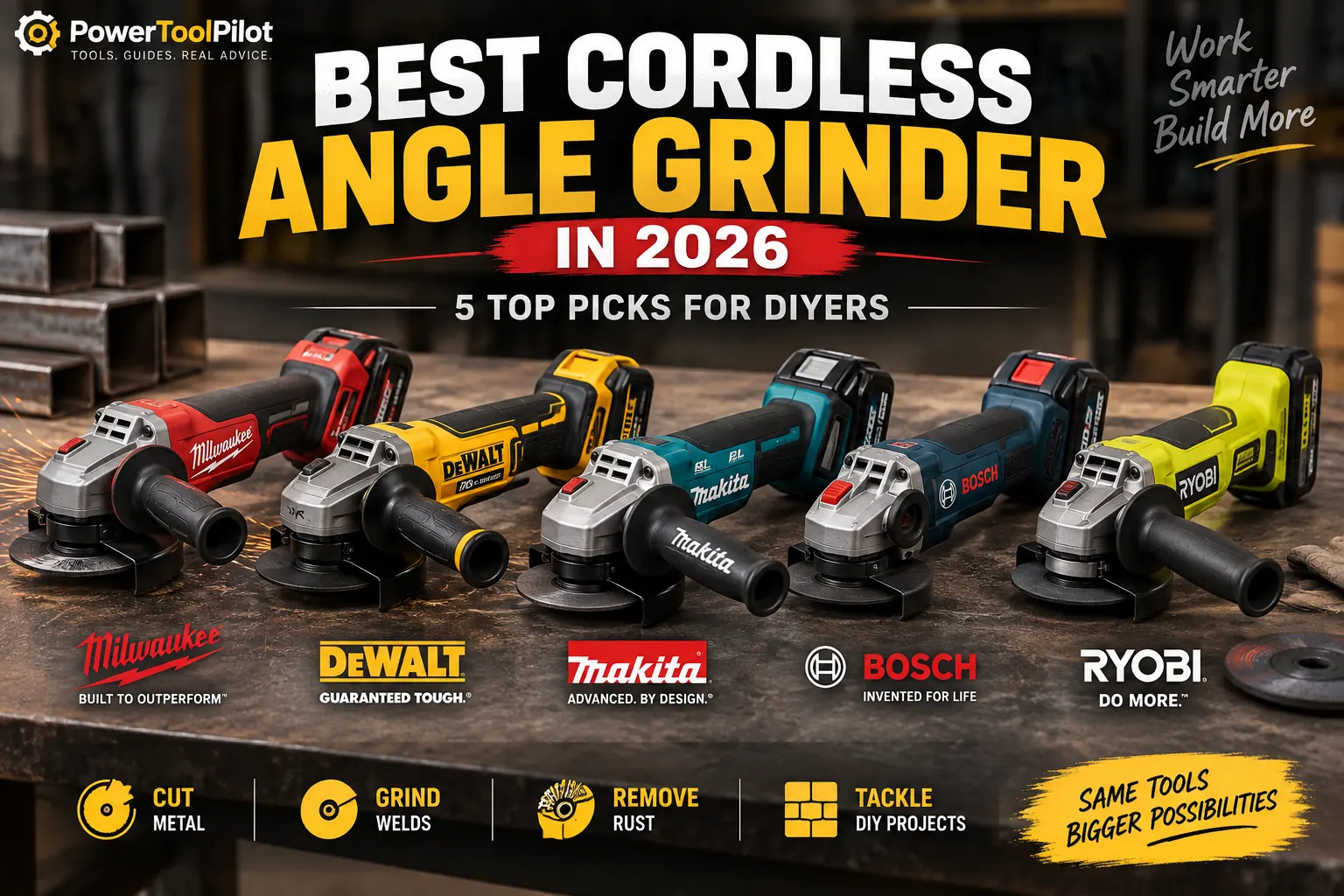
If you regularly work with metal, repair equipment, remove rust, cut bolts, or tackle DIY projects around the house, an angle grinder can be one of the most useful power tools in your workshop.
And if you don’t want to deal with extension cords, a cordless angle grinder gives you the freedom to work almost anywhere.
Modern cordless grinders have come a long way. Brushless motors, electronic brakes, kickback protection, and high-capacity lithium-ion batteries have made today’s models powerful enough for demanding DIY and jobsite work. Popular battery platforms from Milwaukee, DeWalt, Makita, Bosch, and Ryobi also make it easier to share batteries with other cordless tools you already own.
But which one should you buy?
In this guide, we compare 5 of the best cordless angle grinders in 2026 and explain what makes each one a good choice.
Quick Comparison: Best Cordless Angle Grinders in 2026
| Model | Battery Platform | Disc Size | Best For |
|---|---|---|---|
| Milwaukee M18 FUEL 2880-20 | M18 | 4-1/2″ & 5″ | Best Overall |
| DeWalt DCG413B | 20V MAX | 4-1/2″ & 5″ | Best for DIY & Construction |
| Makita XAG04Z | 18V LXT | 4-1/2″ & 5″ | Best for Metalworking |
| Bosch GWS18V-45 | 18V | 4-1/2″ | Best Ergonomics |
| Ryobi PBLAG01B | 18V ONE+ | 4-1/2″ | Best Value |
These models cover different needs, from serious metalworking to occasional home DIY. Specifications and features can vary by exact kit and market, so always check the manufacturer’s listing before purchasing.
1. Milwaukee M18 FUEL 2880-20 — Best Overall Cordless Angle Grinder
Why We Recommend It
The Milwaukee M18 FUEL 2880-20 is one of the strongest choices if you want a professional-grade cordless grinder and already use Milwaukee M18 batteries.
It is designed around Milwaukee’s M18 battery platform and uses a brushless POWERSTATE motor. The grinder can accept both 4-1/2-inch and 5-inch wheels, giving you flexibility for cutting, grinding, and surface preparation.
The tool is also equipped with electronic safety technology designed to reduce the risk associated with kickback and wheel binding. Current 2026 comparisons consistently place the 2880-20 among the leading cordless grinders for demanding work.
Best For
- Heavy-duty DIY projects
- Metal fabrication
- Grinding welds
- Cutting metal
- Removing rust
- Milwaukee M18 users
- Frequent workshop use
Pros
- Powerful brushless motor
- 4-1/2-inch and 5-inch wheel compatibility
- Strong M18 battery ecosystem
- Excellent safety features
- Good choice for demanding work
Cons
- Bare-tool versions don’t include a battery or charger
- More expensive than budget options
- May be more grinder than an occasional DIYer needs
Bottom Line
If you already own Milwaukee M18 batteries and want a serious cordless grinder, the Milwaukee M18 FUEL 2880-20 is one of the easiest recommendations to make.
2. DeWalt DCG413B — Best for DIYers and Construction
The DeWalt DCG413B 20V MAX XR Brushless Angle Grinder is another excellent option for homeowners, DIYers, and construction users.
Its biggest advantage is the DeWalt 20V MAX ecosystem. If you already own a DeWalt drill, impact driver, circular saw, or other 20V MAX tools, buying the bare grinder can make a lot of sense because you may already have compatible batteries and a charger.
The DCG413B is a compact 4-1/2-inch grinder with a brushless motor and electronic safety features, including a brake and kickback-related protection. Current comparisons commonly identify DeWalt’s 20V grinders as strong choices for construction and general-purpose work.
Best For
- DIY projects
- Construction work
- Metal cutting
- Grinding
- Home workshops
- DeWalt 20V MAX users
Pros
- Brushless motor
- Excellent 20V MAX battery ecosystem
- Compact design
- Good safety features
- Strong all-around performance
Cons
- Battery and charger usually sold separately
- Not the cheapest option for someone starting from scratch
Bottom Line
For homeowners already invested in DeWalt’s 20V MAX platform, the DCG413B is a very practical choice.
If you’re deciding between Milwaukee and DeWalt batteries, check out our comparison:
[Milwaukee M18 vs DeWalt 20V: Which Is Better in 2026?]
3. Makita XAG04Z — Best for Metalworking
If your main priority is metalworking, the Makita XAG04Z deserves a close look.
This cordless grinder uses Makita’s 18V LXT battery platform and is designed for 4-1/2-inch and 5-inch wheels. It uses a brushless motor and electronic controls intended to help maintain performance while also protecting the tool from overload and other demanding conditions.
Makita’s LXT ecosystem is particularly attractive for users who already own several Makita 18V tools.
Best For
- Metalworking
- Welding projects
- Grinding welds
- Rust removal
- Fabrication
- Makita LXT users
Pros
- Brushless motor
- 4-1/2-inch and 5-inch wheel compatibility
- Strong LXT ecosystem
- Good control for metalworking
- Cordless convenience
Cons
- Bare-tool package doesn’t include battery
- Less attractive if you don’t already own Makita batteries
Bottom Line
The Makita XAG04Z is a strong option for DIYers and metalworkers who already use Makita’s 18V LXT system.
4. Bosch GWS18V-45 — Best for Ergonomics
Not everyone needs the most powerful grinder available.
For many DIYers, control, handling, and comfort are just as important as raw power. That’s where a compact grinder such as the Bosch GWS18V-45 becomes interesting.
The 18V platform gives Bosch users the ability to share batteries across compatible tools, while the compact grinder design makes it suitable for general cutting and grinding tasks.
Current 2026 comparisons list Bosch’s compact cordless grinder among the notable options for users who prioritize ergonomics and handling.
Best For
- DIYers
- Home workshops
- Light-to-medium metalwork
- Users who value compact tools
- Bosch 18V users
Pros
- Compact design
- Easy to handle
- Good for general-purpose grinding
- Bosch battery compatibility
- Suitable for smaller projects
Cons
- Smaller wheel capacity than some larger grinders
- Not designed to replace a heavy-duty grinder for every application
Bottom Line
If you prefer a compact tool that’s easy to control rather than simply buying the biggest grinder available, the Bosch GWS18V-45 is worth considering.
5. Ryobi PBLAG01B — Best Value
For homeowners and casual DIYers, spending hundreds of dollars on a professional grinder may not make sense.
That’s where the Ryobi PBLAG01B 18V ONE+ HP Brushless Angle Grinder comes in.
Ryobi’s biggest advantage is its enormous ONE+ ecosystem. If you already own Ryobi 18V tools, you can use compatible batteries across the platform, making the grinder much more attractive from a total-cost perspective.
Current 2026 comparisons identify Ryobi’s 18V ONE+ HP grinder as a strong value-oriented choice.
Best For
- Homeowners
- Occasional DIY projects
- Garage workshops
- Budget-conscious buyers
- Ryobi ONE+ users
Pros
- Strong value
- Brushless motor
- Large ONE+ ecosystem
- Good choice for occasional DIY
- Cordless convenience
Cons
- Not aimed at the heaviest professional workloads
- Battery and charger may cost extra
Bottom Line
If you want a cordless angle grinder for occasional home projects and already use Ryobi ONE+, the PBLAG01B can be a smart value choice.
What Can You Do With a Cordless Angle Grinder?
An angle grinder isn’t just for cutting metal.
With the correct wheel or accessory, you can use one for:
1. Cutting Metal
Cut-off wheels can be used for tasks such as cutting:
- Bolts
- Threaded rod
- Metal tubing
- Sheet metal
- Rebar
- Other compatible metal stock
2. Grinding Welds
A grinding wheel can help smooth and clean welds after fabrication.
3. Removing Rust
Wire wheels and other appropriate accessories can remove surface rust from compatible metal surfaces.
4. Cutting Tile and Masonry
With the correct diamond blade and tool setup, an angle grinder can also be useful for certain tile and masonry applications.
5. Surface Preparation
Grinding and flap discs can be used to prepare metal surfaces before painting, welding, or other finishing work.
Always use an accessory specifically rated for the material and grinder, and follow the manufacturer’s instructions.
What Size Angle Grinder Should You Buy?
For most DIYers, a 4-1/2-inch cordless angle grinder is the best place to start.
Why?
It’s relatively compact, easy to control, and suitable for a wide range of common jobs.
A 5-inch-capable model gives you additional flexibility, while larger grinders are generally better suited to specialized or heavy-duty applications.
For general home use, there’s little reason for most beginners to jump straight to a large professional grinder.
Cordless vs. Corded Angle Grinder
One of the biggest decisions you’ll make is whether to buy cordless or corded.
Cordless Angle Grinder
Advantages
- No extension cord
- Easy to move around
- Great for outdoor work
- Convenient on construction sites
- Easy to use in areas without nearby outlets
Disadvantages
- Battery runtime is limited
- Batteries add weight
- Replacement batteries can be expensive
- Heavy continuous grinding can consume batteries quickly
Corded Angle Grinder
Advantages
- Continuous power
- No battery charging
- Often less expensive
- Excellent for long workshop sessions
Disadvantages
- Requires an electrical outlet
- Extension cords can be inconvenient
- Less portable
Which One Should You Choose?
If you’re doing occasional work around a garage or workshop with easy access to electricity, a corded grinder can still make sense.
But if you already own a cordless battery platform, a cordless grinder is usually much more convenient.
Why Your Battery Platform Matters
This is one of the most important things to consider before buying a cordless angle grinder.
If you already own several cordless tools, don’t automatically choose a grinder based only on its specifications.
Instead, look at your existing batteries.
For example:
- Already own Milwaukee M18 batteries? Consider Milwaukee.
- Already own DeWalt 20V MAX batteries? Consider DeWalt.
- Already own Makita 18V LXT batteries? Consider Makita.
- Already own Ryobi ONE+ batteries? Consider Ryobi.
- Already invested in Bosch’s compatible 18V system? Consider Bosch.
Buying within the same battery platform can save you from purchasing another charger and another set of batteries.
This is especially important because most popular cordless grinders are sold as bare tools, meaning the battery and charger are not included.
What to Look for When Buying a Cordless Angle Grinder
1. Brushless Motor
A brushless motor is generally preferable for cordless tools because of its efficiency and reduced maintenance requirements.
For frequent use, I’d prioritize a brushless model.
2. Wheel Size
For most DIY applications, 4-1/2-inch models are a great starting point.
Some grinders also support 5-inch wheels.
3. Electronic Brake
A brake can stop the wheel more quickly after the tool is released.
This is a useful safety feature, particularly on a tool that spins at very high speed.
4. Kickback Protection
Look for a grinder with electronic protection designed to reduce the tool’s response to a sudden bind or kickback condition.
Different manufacturers use different names and systems for these features.
5. Paddle vs. Slide Switch
Both designs have advantages.
A paddle switch can be convenient because it can be released quickly, while slide switches can provide a different style of operation.
Choose the design that you can comfortably control.
6. Battery Capacity
A larger battery can provide more runtime, but it also adds weight.
For light DIY work, a smaller battery may be perfectly adequate.
For long cutting or grinding sessions, a higher-capacity battery can be worthwhile.
Are Cordless Angle Grinders Powerful Enough?
For most DIY jobs, yes.
Modern cordless grinders from major manufacturers can provide plenty of performance for cutting, grinding, rust removal, and general metalworking.
The biggest limitation isn’t necessarily peak power — it’s runtime.
If you’re grinding continuously for long periods, even a high-capacity battery can eventually need to be swapped or recharged.
That’s why professional users often keep multiple batteries available.
Safety Tips for Using an Angle Grinder
An angle grinder is a high-speed cutting and grinding tool, so safety should never be an afterthought.
Always:
- Wear appropriate eye protection.
- Use a face shield when the application calls for it.
- Wear hearing protection.
- Use the correct guard.
- Use wheels and accessories rated for your grinder.
- Inspect discs before use.
- Keep both hands on the tool when appropriate.
- Keep bystanders away from sparks and debris.
- Secure the workpiece before cutting or grinding.
- Follow the manufacturer’s instructions.
- Never use a damaged or cracked wheel.
Most importantly, never remove the safety guard simply because it makes the tool easier to use.
A grinder can throw sparks, fragments, and debris at high speed. Treat it with the same respect you would give any other high-speed cutting tool.
Which Cordless Angle Grinder Is Best for You?
Here’s our quick recommendation:
Best Overall
Milwaukee M18 FUEL 2880-20
Best choice for serious DIYers and professionals who want strong performance and already use the M18 platform.
Best for DeWalt Users
DeWalt DCG413B
A great choice for homeowners and contractors already invested in the DeWalt 20V MAX ecosystem.
Best for Metalworking
Makita XAG04Z
A strong option for users who prioritize metalworking and already own Makita LXT batteries.
Best for Ergonomics
Bosch GWS18V-45
A compact option for DIYers who prioritize handling and control.
Best Value
Ryobi PBLAG01B
A sensible option for homeowners who want cordless convenience without stepping into the most expensive professional platforms.
Final Verdict
The best cordless angle grinder in 2026 isn’t necessarily the most powerful model — it’s the one that fits your work and battery platform.
For most serious DIYers, the Milwaukee M18 FUEL 2880-20 is an excellent all-around choice.
If you’re already invested in DeWalt’s 20V MAX system, the DeWalt DCG413B makes a lot of sense.
For Makita users, the XAG04Z is a strong choice, while Bosch offers a compact alternative for users who value ergonomics.
And if you’re a homeowner looking for good performance without spending professional-level money, the Ryobi PBLAG01B deserves a look.
Before buying, compare the bare-tool price with the cost of a battery and charger. If you already own compatible batteries, choosing the same platform can often be the smartest move.
Frequently Asked Questions
What is the best cordless angle grinder in 2026?
For an overall combination of performance, safety features, and battery-platform compatibility, the Milwaukee M18 FUEL 2880-20 is one of the strongest choices. DeWalt, Makita, Bosch, and Ryobi also offer compelling options for different users.
Is a cordless angle grinder powerful enough for cutting metal?
Yes. Modern cordless angle grinders can handle many common metal-cutting tasks when paired with the correct wheel. For extended heavy-duty work, however, battery runtime becomes an important consideration.
Is Milwaukee better than DeWalt for angle grinders?
Neither brand is automatically better for everyone. If you already own M18 batteries, Milwaukee may be the better choice. If you own DeWalt 20V MAX batteries, a DeWalt grinder can offer better overall value.
What size cordless angle grinder is best for DIY?
For most homeowners and DIYers, a 4-1/2-inch grinder is a versatile starting point. Some 5-inch-capable models provide additional flexibility.
Can I use any grinding wheel on a cordless angle grinder?
No. Always use wheels and accessories that are compatible with the specific grinder and rated for the intended application. Follow the grinder and accessory manufacturer’s instructions.
Should I buy a cordless or corded angle grinder?
Choose cordless if portability and convenience are important, especially if you already own batteries from the same platform. Choose corded if you expect long periods of continuous grinding near an electrical outlet.
Do cordless angle grinders come with batteries?
Many popular models are sold as bare tools, so the battery and charger are often purchased separately. Check the exact package before ordering.
Related PowerToolPilot Guides
If you’re building a cordless power-tool collection, check out our other guides:
- Best Cordless Drill for Home Use in 2026: 7 Top Picks for Homeowners
- Best Cordless Impact Driver in 2026: 5 Top Picks for DIYers
- Best Cordless Circular Saw in 2026: 5 Top Picks for DIYers
- Best Cordless Angle Grinder in 2026: 5 Top Picks for DIYers
- Milwaukee M18 vs DeWalt 20V: Which Is Better in 2026?
- Milwaukee M18 vs M12: What’s the Difference and Which Should You Choose?
Affiliate Disclosure
PowerToolPilot may earn a commission when you purchase products through links on this page, at no additional cost to you. Our recommendations are based on product specifications, intended use, features, and overall value.