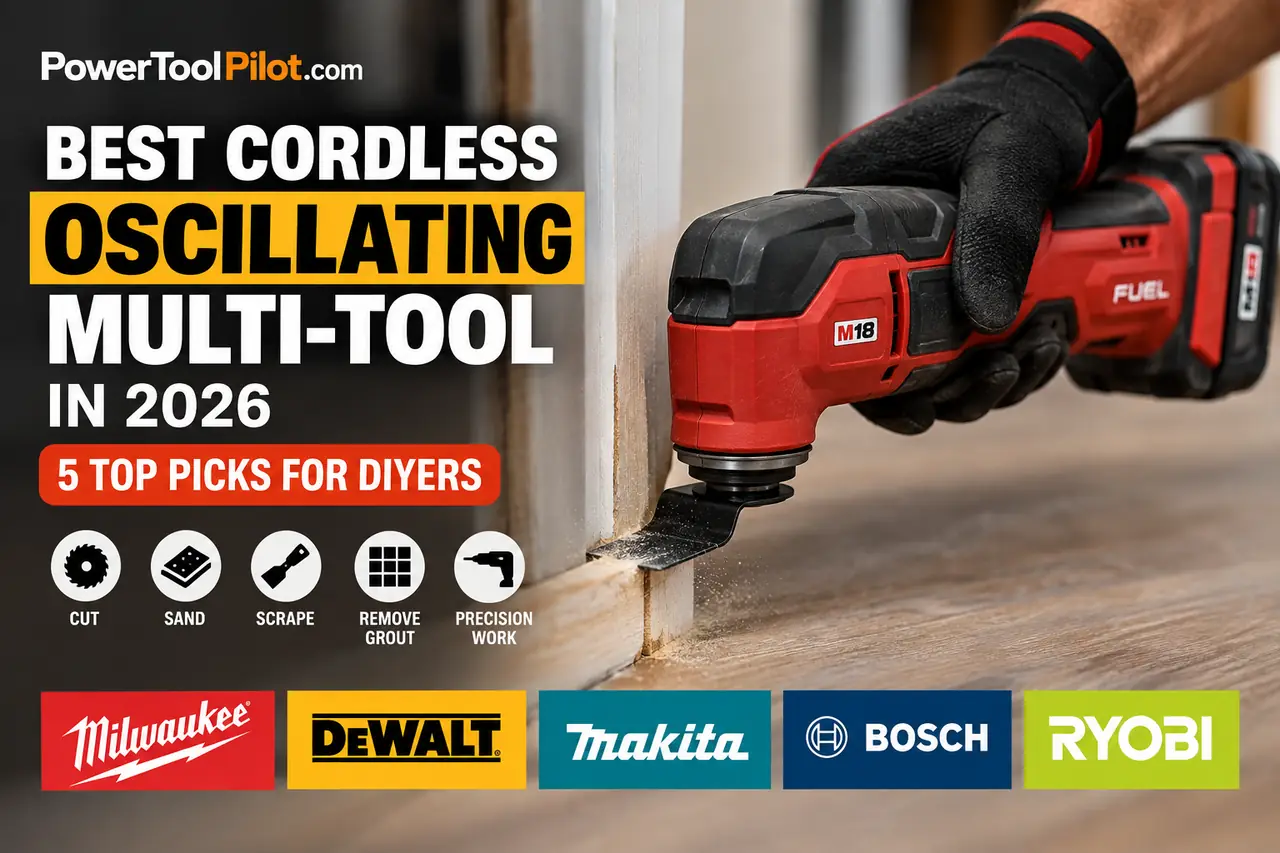
If you want one cordless tool that can handle a surprisingly wide range of small renovation and repair jobs, an oscillating multi-tool is hard to beat.
Unlike a circular saw or reciprocating saw, an oscillating multi-tool is designed for precision work in tight spaces. You can use it to make flush cuts, trim door jambs, remove grout, scrape adhesive, sand corners, cut drywall, and tackle many other DIY jobs.
The biggest advantage of going cordless is simple: no extension cord and much better portability.
In 2026, manufacturers such as Milwaukee, DeWalt, Makita, Bosch, and Ryobi offer capable cordless oscillating multi-tools. The differences come down to cutting performance, vibration, speed control, blade compatibility, battery platform, and price.
In this guide, we’ll compare 5 of the best cordless oscillating multi-tools in 2026 and explain which one makes the most sense for different types of DIYers.
Quick Comparison: Best Cordless Oscillating Multi-Tools in 2026
| Oscillating Multi-Tool | Battery Platform | Best For | Key Advantage |
|---|---|---|---|
| Milwaukee M18 FUEL 2836-20 | M18 | Best Overall | Powerful cutting and low vibration |
| DeWalt DCS356B | 20V MAX | Best for DIYers | 3-speed control |
| Makita XMT04Z | 18V LXT | Best for Comfort | Smooth operation and versatility |
| Bosch GOP18V-34N | 18V | Best for Blade Compatibility | StarlockPlus system |
| Ryobi PBLMT51B | 18V ONE+ | Best Value | Affordable ONE+ platform |
Note: Prices, kits, batteries, and included accessories can vary. Many cordless multi-tools are sold as bare tools, so check the exact package before buying.
1. Milwaukee M18 FUEL 2836-20 — Best Overall
If you’re looking for a powerful cordless oscillating multi-tool and already use Milwaukee M18 batteries, the Milwaukee M18 FUEL 2836-20 is one of the strongest choices.
Milwaukee says the 2836-20 is designed to provide fast cuts, demolition power, and low full-tool vibration. The tool uses Milwaukee’s M18 battery platform and is part of the FUEL line.
Its performance makes it particularly attractive for serious DIYers, remodelers, and professionals who regularly use an oscillating tool.
Best For
- Remodeling
- Heavy-duty DIY
- Flush cutting
- Cutting wood with embedded nails
- Removing grout
- Scraping
- Milwaukee M18 users
Pros
- Excellent cutting performance
- Brushless FUEL motor
- Low-vibration design
- Strong M18 battery ecosystem
- Suitable for demanding applications
Cons
- Higher price than budget models
- Battery and charger may cost extra
- More tool than occasional DIYers may need
Bottom Line
If performance is your priority and you’re already invested in Milwaukee’s M18 system, the M18 FUEL 2836-20 is an excellent all-around choice.
2. DeWalt DCS356B — Best for DIYers
The DeWalt DCS356B 20V MAX XR Brushless 3-Speed Oscillating Multi-Tool is a particularly versatile choice for homeowners and DIYers.
One of its biggest advantages is the 3-speed selector, which allows you to adjust the tool for different applications. DeWalt lists a no-load speed of up to 20,000 OPM and includes a universal accessory adapter for compatibility with most oscillating-tool accessories.
The DCS356 also uses a brushless motor and a quick-change accessory system.
Best For
- Homeowners
- DIY projects
- Remodeling
- Flooring projects
- Cutting wood
- Sanding
- DeWalt 20V MAX users
Pros
- 3-speed control
- Brushless motor
- Up to 20,000 OPM
- Quick-change accessory system
- Universal accessory adapter
- Excellent 20V MAX ecosystem
Cons
- Bare-tool version doesn’t include battery or charger
- More expensive than entry-level models
Bottom Line
If you’re already using DeWalt 20V MAX tools, the DCS356B is one of the easiest multi-tools to recommend.
The 3-speed control also makes it useful for DIYers who want more control over different materials and applications.
3. Makita XMT04Z — Best for Comfort and Control
Makita’s 18V LXT platform is another excellent choice for cordless tool users.
The Makita XMT04Z is designed for users who want a versatile oscillating multi-tool without giving up the convenience of cordless operation.
It is particularly attractive if you already own Makita 18V LXT batteries.
Best For
- DIYers
- Home renovation
- Sanding
- Flush cutting
- Detail work
- Makita LXT users
Pros
- Good ergonomics
- 18V LXT battery compatibility
- Variable-speed operation
- Suitable for many applications
- Strong professional tool ecosystem
Cons
- Battery and charger may be sold separately
- Not the cheapest option for someone starting from zero
Bottom Line
The Makita XMT04Z makes the most sense for users who already own Makita LXT batteries or want to build a larger Makita cordless tool collection.
4. Bosch GOP18V-34N — Best for Blade Compatibility
Bosch takes a slightly different approach with its professional oscillating multi-tools.
The Bosch GOP18V-34N uses the StarlockPlus accessory system, which is designed for a secure connection between the tool and accessory.
For users who frequently change blades and accessories, the blade interface can be just as important as motor power.
Best For
- Precision work
- Remodeling
- Flooring
- Detail sanding
- Users who frequently change accessories
- Bosch 18V users
Pros
- Brushless motor
- StarlockPlus accessory system
- Good control
- Compact design
- Strong professional ecosystem
Cons
- Starlock accessories can cost more
- Accessory compatibility needs to be checked before buying
Bottom Line
If you expect to use lots of different blades and accessories, the Bosch GOP18V-34N is worth considering.
Before purchasing accessories, always check whether they are compatible with the exact Starlock level supported by your tool.
5. Ryobi PBLMT51B — Best Value
For homeowners who don’t need professional-level performance every day, Ryobi’s ONE+ platform offers an attractive alternative.
The Ryobi PBLMT51B is a brushless 18V ONE+ oscillating multi-tool designed for general DIY applications.
The biggest advantage isn’t just the tool itself—it’s the huge ONE+ ecosystem.
If you already own Ryobi batteries, adding an oscillating multi-tool can be relatively straightforward because the same battery platform can be used across many compatible tools.
Best For
- Homeowners
- Occasional DIY
- Garage projects
- Small repairs
- Budget-conscious buyers
- Ryobi ONE+ users
Pros
- Good value
- Brushless motor
- ONE+ battery compatibility
- Suitable for common DIY jobs
- Large ecosystem of compatible tools
Cons
- Not intended to replace a heavy-duty professional tool
- Battery and charger may be sold separately
Bottom Line
If you’re building a DIY tool collection on a budget, the Ryobi PBLMT51B deserves serious consideration.
What Is an Oscillating Multi-Tool Used For?
The biggest reason to buy an oscillating multi-tool is versatility.
You can use the correct blade or accessory for tasks such as:
Flush Cutting
An oscillating tool can cut material almost flush with another surface.
For example, you can use it to trim:
- Door jambs
- Baseboards
- Wooden shims
- Small pieces of lumber
- PVC and other compatible materials
This is particularly useful when installing flooring.
Removing Grout
With the appropriate grout-removal accessory, an oscillating tool can help remove old grout from tight areas.
Cutting Drywall
A suitable blade can make controlled cuts in drywall for electrical boxes and other openings.
Scraping
Scraper blades can help remove:
- Adhesive
- Caulk
- Paint
- Vinyl
- Other compatible materials
Sanding
A triangular sanding pad makes an oscillating tool useful for getting into corners and other areas where a conventional sander may struggle.
Cutting Nails and Screws
With an appropriate metal-cutting blade, an oscillating tool can cut certain nails, screws, and other thin metal components.
Why Buy a Cordless Oscillating Multi-Tool?
The main advantage is portability.
A corded multi-tool can be excellent for long sessions in a workshop, but a cordless model is much easier to carry around a house or jobsite.
Advantages of Cordless
- No extension cord
- Easy to move around
- Better for jobsites
- Convenient for quick repairs
- Works away from electrical outlets
- Easy to use in tight spaces
Disadvantages
- Battery runtime is limited
- Batteries add weight
- Replacement batteries can be expensive
- Long jobs may require multiple batteries
For most homeowners, the convenience of cordless operation is worth it.
What Should You Look for in a Cordless Oscillating Multi-Tool?
1. Brushless Motor
If you plan to use the tool regularly, a brushless motor is worth considering.
Brushless motors are generally more efficient and are now common in higher-end cordless tools.
2. Variable Speed
Different materials and accessories work better at different speeds.
A tool with variable-speed control gives you more flexibility.
The DeWalt DCS356B, for example, provides a 3-speed selector and up to 20,000 OPM no-load speed.
3. Vibration Control
Oscillating tools vibrate by design.
However, excessive vibration can make long jobs uncomfortable.
If you plan to use the tool for extended sanding, scraping, or cutting sessions, vibration control should be an important consideration.
4. Blade Compatibility
Don’t overlook this.
Different oscillating tools can use different accessory systems.
Some use universal/OIS-style accessories, while systems such as Starlock provide a different mounting design.
Before buying a tool, check the cost and availability of the blades you expect to use.
5. Battery Platform
This may be the most important factor for existing cordless-tool users.
If you already own:
- Milwaukee M18 → consider Milwaukee
- DeWalt 20V MAX → consider DeWalt
- Makita 18V LXT → consider Makita
- Bosch 18V → consider Bosch
- Ryobi ONE+ → consider Ryobi
Staying within the same platform means you may not need another charger and battery.
Oscillating Multi-Tool vs. Reciprocating Saw
These tools can overlap, but they aren’t really designed for the same jobs.
| Feature | Oscillating Multi-Tool | Reciprocating Saw |
|---|---|---|
| Precision | Excellent | Moderate |
| Tight spaces | Excellent | Good |
| Flush cutting | Excellent | Limited |
| Demolition | Good | Excellent |
| Large wood cuts | Limited | Excellent |
| Grout removal | Excellent | Not suitable |
| Sanding | Yes | No |
| Scraping | Yes | No |
| Portability | Excellent | Excellent |
If you’re doing precision work and small repairs, choose an oscillating multi-tool.
If you’re doing demolition and cutting larger materials, a reciprocating saw is generally the better choice.
We’ll cover cordless reciprocating saws in a future PowerToolPilot guide.
What Is the Best Oscillating Multi-Tool for Homeowners?
For most homeowners, I would narrow the choice down to three.
Best Overall: Milwaukee M18 FUEL 2836-20
Choose this if performance is your priority or you already own M18 batteries.
Best All-Around DIY Choice: DeWalt DCS356B
Choose this if you want speed control, versatility, and already use DeWalt 20V MAX batteries.
Best Value: Ryobi PBLMT51B
Choose this if you’re building a DIY tool collection and want to keep costs under control.
Cordless Oscillating Multi-Tool Buying Tips
Before clicking the Buy button, consider these questions.
Do I already own batteries?
If yes, stay within that battery platform unless there’s a compelling reason not to.
How often will I use it?
If it’s only for occasional home repairs, you probably don’t need the most expensive professional model.
What accessories will I use?
Check blade compatibility before purchasing the tool.
Do I need a kit or bare tool?
If you already have batteries, a bare tool can save money.
If you’re starting from scratch, a kit that includes a battery and charger may offer better overall value.
Will I use it for long periods?
If yes, prioritize vibration control, ergonomics, and battery capacity.
Final Verdict
The best cordless oscillating multi-tool in 2026 depends heavily on the battery platform you already use.
For serious DIYers and professionals, the Milwaukee M18 FUEL 2836-20 is an excellent high-performance choice.
The DeWalt DCS356B is one of the most versatile options for homeowners and DIYers, especially because of its 3-speed control and universal accessory adapter. DeWalt officially lists up to 20,000 OPM and a brushless motor for the DCS356 platform.
The Makita XMT04Z is a strong option for users already invested in the 18V LXT ecosystem.
The Bosch GOP18V-34N is worth considering if accessory compatibility and the StarlockPlus system are important to you.
And for budget-conscious homeowners, the Ryobi PBLMT51B provides a practical way into the ONE+ ecosystem.
Our Picks at a Glance
Best Overall: Milwaukee M18 FUEL 2836-20
Best for DIYers: DeWalt DCS356B
Best for Makita Users: Makita XMT04Z
Best for Blade Compatibility: Bosch GOP18V-34N
Best Value: Ryobi PBLMT51B
The smartest purchase, however, is often the one that matches the cordless battery system you already own.
Frequently Asked Questions
What is the best cordless oscillating multi-tool in 2026?
The Milwaukee M18 FUEL 2836-20 is one of the strongest overall choices for demanding users. The DeWalt DCS356B is another excellent option for homeowners and DIYers.
What can an oscillating multi-tool do?
It can cut, sand, scrape, remove grout, trim door jambs, cut drywall, and perform many other precision tasks when equipped with the appropriate accessory.
Is an oscillating multi-tool worth buying?
Yes, especially if you regularly work on home repairs, flooring, remodeling, or DIY projects where access is limited.
Is Milwaukee better than DeWalt for oscillating tools?
Neither is automatically better for everyone. Milwaukee is a strong choice for M18 users, while DeWalt’s DCS356B offers useful 3-speed control and broad accessory compatibility.
Can an oscillating tool cut metal?
Yes, with the correct metal-cutting accessory and proper technique. Always use an accessory rated for the material and tool.
Can I use any blade on an oscillating multi-tool?
No. Blade compatibility depends on the tool’s accessory interface. Check the manufacturer’s compatibility information before purchasing accessories.
Is a cordless or corded oscillating tool better?
Cordless models are generally more convenient for homeowners and jobsites because they eliminate the need for an extension cord. Corded models can still make sense for long, continuous workshop use.
Do cordless oscillating tools come with batteries?
Not always. Many models are sold as bare tools, while kit versions include a battery and charger. Always check the exact model/package before ordering.
Related PowerToolPilot Guides
If you’re building a cordless power-tool collection, check out our other guides:
- Best Cordless Drill for Home Use in 2026: 5 Top Picks for Homeowners
- Best Cordless Impact Driver in 2026: 5 Top Picks for DIYers
- Best Cordless Circular Saw in 2026: 5 Top Picks for DIYers
- Best Cordless Angle Grinder in 2026: 5 Top Picks for DIYers
- Milwaukee M18 vs DeWalt 20V: Which Is Better in 2026?
- Milwaukee M18 vs M12: What’s the Difference and Which Should You Choose?
Affiliate Disclosure
PowerToolPilot may earn a commission when you purchase products through links on this page, at no additional cost to you. Our recommendations are based on product specifications, intended use, features, and overall value.